Showing posts with label Orenburg. Show all posts

18 May 2009

Light at the End of the Tunnel

Hello,

Another quarter gone by and semi-good news from my company. No more 25% time (and pay) reduction, but 10% pay reduction across the board! Could be worse … could be worse. Whether this is temporary or permanent we don’t yet know – they will decide quarter-to-quarter. So we’re looking at it as a 15% pay increase compared to last quarter :-)


I haven’t seen the new Star Trek movie yet, but I’m reading the reviews which are mostly positive. One of the more entertaining ones is here: – this review covers an aspect that never occurred to me: Twinks and Bears. After reading it my husband declared that now he can never look at Star Trek the same way again! Ach – and don’t make an extra effort to watch Angels and Demons – it’s pretty mediocre. If I hadn’t read the book, I would have had trouble following the “plot” which has some major holes in it, anyway. The da Vinci Code was much better. But you do get to see some of Rome’s art treasures!


During the last few weeks I ran into Borders and/or Barnes and Noble every few days so I would not miss the next issue of The Knitter – it’s a UK knitting magazine NOT aimed at the beginner, unlike the majority of other knit mags – I love it. Instead of just showing you some glam photos, they actually have photos of details! Unfortunately, you cannot subscribe to it here in the US, the link only gets you to a page where you can sign up to receive updates about the magazine.


A short while ago I received a pattern update for the Rosebud Neckwarmer designed by Grace Mcewen ... you can also find it on Ravelry. Very nice. It now includes charts, which is a huge Plus in my book. I hate reading written row-by-row instructions, because I have to *read* them … a chart, on the other hand … I can just *look* at it and see where I am (or should be). That’s the same reason I like analog clocks better than digital ones – I look at an analog clock and can *see* what time it is … a digital clock I have to first read, then translate what I read to the actual time. Anyway …

My next larger project after the Funnelneck sweater will be from the latest PieceWork magazine (May/June 2009): Olga’s Indiski (Indian) Shawl to Knit by Galina Khmeleva. This shawl was originally designed by the late Olga Fedorova, Galina’s mentor, and expert Orenburg Shawl knitter, and modified a bit by Galina. I’m thinking of knitting the original pattern also shown in the magazine, to fill the large “empty” squares. I had a Russian colleague translate the writing in this picture, but it didn't contain any interesting info.


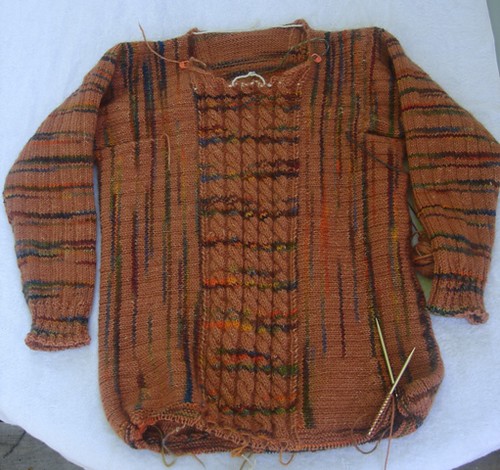
Regarding the Funnelneck Sweater: I’m working on the bottom band right know, about 2 inches done, which seems sufficient … the pattern calls for 3 inches, but I’ll try it on and see how it looks with 2. So I am finally seeing the light at the end of the knit-reknit tunnel for this sweater.


The feral rooster is gone now. Poor fellow – he was just being a rooster. But the neighbors became more and more annoyed with him, and since he and his girlfriend spent a lot of time in our yard, we had the best opportunity of catching him. There is a slim chance that he might find a new home on a farm somewhere, but it’s not likely. Sigh. It’s too bad that there are not enough no-kill shelters like Best Friends. After a few days of extreme caution towards humans, the chicken is her old self again and happily scratches around in the neighborhood yards – I’m really surprised she is still alive. She’s been around for several years now.


Take care!

11 February 2009

Lace-Making Retreat at Lacis Report

Whew! It was a busy week!

Galina Khmeleva kept us occupied knitting samples day and night (homework!), and I learned a lot from her.
I took all of her classes: Orenburg Shawl Fundamentals (knitting a gossamer web shawl), Knitting a Warm Shawl, and Dimensional Knitting (spiders and bobbles). Of course, there were the other classes on lace-making: Needle Lace, Bobbin Lace and Tatting. Since the Dimensional Knitting classes were repeated, I was able to take a sniffer class in Bobbin Lace which was interesting, but it's not my cup of tea at the moment. Here is the result of an hour's worth of effort:

Beginner's Bookworm - I did most of the top half, then the instructor
(a very patient Maria Provencher) finished the bottom half, because
I was running out of time.


There were 2 classes per day: one morning and one afternoon session (10:30 to 1:00 pm and 3:00 to 5:30 pm), which gave us a rather long lunch break, but enabled us to catch up on our sample-knitting. This was our workshop area (former software office):

And one dedicated lunch-break knitter:

You can see Galina's sampler hanging from the shelf.

Orenburg Fundamentals Class: Galina took us through the making of a sample gossamer shawl, as described in her books, but with more information and tips.

Orenburg Gossamer Shawl sample

She started out by making us knit samples of the basic Orenburg patterns (Strawberries, Honeycomb, Peas, etc.) in yarn she provided - I found out that I had been knitting with needles too large (2.5 mm) and she made me switch to 1.5 mm (US 000) needles, because the holes should not quite be big enough for your pinkie to slip through. Using the smaller needles indeed made my stitches more defined and neater (see bottom, green portion of the sampler - unfortunately, the picture is not that great - the difference is actually visible):

Orenburg stitch sampler, and grafting sample

To the left of it you see two squares grafted together on two sides using the Russian grafting method.

Warm Shawl Class: In contrast to a gossamer shawl, a warm shawl is knitted in pieces: You knit 2 (for a triangular shawl) or 4 (for a square shawl) trapezoid border pieces; you pick up stitches on the short side and knit a "bridge" on each piece; then you graft 2 (for a triangular shawl) or 3 (for a square shawl) pieces together and start knitting the center (picking up border stitches as you work), then you attach the top trapezoid border (for the square version) or a border (for a triangular shawl). The bridge (not in the sample pictured) gives a warm shawl more stability, so it keeps its shape better than a gossamer shawl, which would have to be blocked more frequently with wear.

Three trapezoids for an Orenburg Warm Shawl.

To make a triangular shawl the pink and yellow pieces one have been grafted together; then the stitches on the short pink one were picked up, and the center (turquoise) was knitted up from the pink, decreasing stitches on its left side to produce a straight line for the triangular shawl's long (diagonal) side. If you wanted to knit a square shawl, you would graft the taupe trapezoid to the yellow one, pick up the yellow top stitches and knit straight up, picking up stitches from both the pink and taupe pieces as you knit up. Then attach another trapezoid piece on top to finish the shawl. Galina will have a pattern for a triangular warm shawl in the next issue of Piecework magazine (May/June 2009).

We also received plenty of good information on yarn characteristics. For instance:
Alpaca wool (I had considered it for my first real O-shawl) is not a good choice for shawls and tablecloths etc., because it has almost no memory. Also, a very fuzzy yarn like 100% Qiviuk or cashmere is not good for gossamers, because the fuzziness will cover up the holes which you want visible ("Don't cover up your hard work!"). It should be knitted together with some silk, so it keeps its shape and stitch definition better. 100% cashmere and quiviuk are better for warm shawls, because warm shawls have a less lacy (= fewer holes) design, in order to ... keep you warm.

Galina also showed us howe to properly block an Orenburg shawl (it was a method new to me),
and entertained us with lots of stories from Russia (even what to do, Russian-style, with an unfaithful husband!). To top it off, she had boxes and boxes of beautiful yarns, and cloud-soft shawls on display for us (no photos of these, but we were allowed to take notes of the patterns). The most spectacular one was knitted by her mentor Olga Fedorova, who passed away last year.

Galina's class was very good and enjoyable - if you have a chance, take a class from her! Next, she will be at Stitches West in Santa Clara, California and then at the Black Sheep Gathering in Oregon, where she will teach Orenburg-style spinning.

The only negative thing I have to report is that the Lacis Museum was hospitable only in so far as providing a venue was concerned. On the first day, when I signed up for all of Galina's classes (which were the only reason I signed up for this retreat), Mr. Kliot gave me a somewhat disapproving look, because apparently his vision was that everyone should be taking classes in all types of lace-making. Well, I do not have any interest in the other forms of lace-making at this time, because I am just starting to explore lace knitting. It would also have been nice if the museum had provided a little welcome package - maybe with a map to the locations mentioned on their website, since many participants were not local ... or ... dare I say it? ... a coupon good for xx% off something in the store?

In the morning of the first day there was a "Round Table" - which I expected was where the instructors would be introduced and maybe give us a little overview of their particular craft. Instead Mr. Kliot, who did not even bother to introduce himself, only gave a little talk about how we should try out all the different methods of lace-making. Anyway, the round table turned out to be tables set up by the instructors:

"Round Table" - Left foreground: Galina's table with some of her scrumptious shawls, left background: bobbin lace, center: needle lace, right: tatting.

So I felt that a good part of the first day (the first actual class did not start until the afternoon) was wasted - additionally, no spaces were assigned to the different instructors, so you had no place to put your bag(s). Oh well ... But, all in all, the classes and instructors were great, and that was the reason I went.

And this is what you see on entering the workshop area:

Inspiration

Take care!

01 February 2009

Hanami Progress and looking forward to Lacis Workshop!

Things have been a bit stressful at work lately ... since I am taking off part of next week and the following week for the Lace Making Retreat at the Lacis Museum in Berkeley, I had to work a bit longer during the week and even come to work the last 2 Saturdays! But no, they are not exploiting me - I will be able to take off 2 days later, when the project is done. That's the curse when you are the only one in the company with the necessary language skills. It always works out that way, though ... I could be throwing a dart, blindfolded, at a calendar and say that is the week I want to take a vacation - it doesn't matter when - it will somehow work out to be the week when something urgent having to do with a German project will be surfacing. Sheeesh!

In the meantime, I'm making progress on the Hanami stole:

Hanami Stole - 8 Basketweave repeats plus 1 Chart A, with 4 additional rows inserted

Here is a closeup of the Basketweave pattern:

Basketweave pattern

And here is the transition to the cherry-blossom part of the stole:

Transition from Basketweaves to Cherry-Blossom part

Since I knitted one extra repeat of the Basketweave chart, I inserted 8 additional rows into Chart A where you see the 2 lifelines close together. I will knit 4 more 8-row insertions in the following patterns, because I will also shorten the very last pattern by 8 rows. The other lifelines show the pattern repeats - I left them in, because they will help me stretch the stole evenly later once it's done.

Within the last few days I (finally!) received 2 books I was waiting for:

Burda Praxis Strickspitze
and

Estonian Lace Knitting

The Burda Praxis Strickspitze book is a nice basic course of the technique of knitted lace or lace-knitting (depending on whether every row or every other row is patterned). There are several smaller projects in there - some look like Niebling designs to me, but the designer is not named - mostly doilies, plus lampshades, curtains, and borders. This book, which I ordered from Germany, is a lot thinner than I expected, but contains solid information.

Estonian Lace Knitting is fairly broad in scope, with a brief history of the Haapsalu lace knitting tradition, plus some nice scarf and stole patterns. In contrast to it is this book I bought a while ago:

= Lily of the Valley - Variations of a traditional knitting pattern

Maiglöckchen concentrates on one particular pattern which the author received from a Ms. Edith Haller, who was born in Russia. It is a basic Haapsalu Lily of the Valley pattern and is explored in many different projects: sweaters, moebius scarf, hats, bags, socks, curtains and a pillow. Both books together would make one great book.

During the Lace Making workshop I will try to post as often as possible to share what I've learned. I'm planning to take all of Galina Khmeleva's classes on Knitted Lace, so I can expand my knowledge of how to create a nice Orenburg Shawl.

Take care!

07 December 2008

New Acquisitions

Friday's mail brought 2 great books: Oma’s Strickgeheimnisse (Grandma's Knitting Secrets) by Eichenseer, Grill and Krön, and Poems of Color by Wendy Keele.


My two new books


Poems of Color describes the history of the beautiful, colorful Bohus sweaters, the techniques, and includes some patterns, with colored charts. A great resource and interesting reading.


Oma’s Strickgeheimnisse is a German book of patterns, most of which date back to the years 1815 to 1870. Each pattern is charted only (with German chart symbols, of course – clearly explained in the front of the book), and – this is very helpful – provides separate charts for knitting it in the round and back-and-forth.


This pattern is called Perlmutter-Fächer (Mother-of-Pearl Fan)


The photos are clear, and in some cases variations are shown:


This pattern is called Floras Gaben (= Flora’s Bounty)


The top version was knitted in the round, the bottom version was knit back-and-forth.

The patterns are grouped into Strips, Ladders, Flowers and Leaves, Bugs and Beetles and so on, obviously named after things encountered in everyday life on the farms and in the villages, where most of the patterns evolved.


So far I’ve knitted 4 Orenburg Sample shawls, here is the latest:


This is the Fish Eyes pattern, plus Border 1 from the book

The Gossamer Webs Design Collection by Galina Khmeleva


I also finished my Something Teal cardigan:


Something Dark Teal cardigan


The sleeves are 3/4 sleeves. I might re-do the border again, because it looks rather stretched, but for now I'm declaring it done. The pattern is Something Red by Wendy Barnard. More details are on my Ravelry page (gjabouri).


The bad news is that the Lacis Museum’s “A Week of Lacemaking” Urban Retreat might not take place. Apparently they are still short a few people (some who signed up canceled due to the bad economy) – so if you were thinking about joining (and can still afford it), please sign up.


Take care.

03 September 2008

I LOVE YOUR BLOG Award

03 September 2008: Wow! Somebody actually reads my blog!!! And gave me this award:

Thank you, Halfmaennchen!  Since the *rules* state that you have to ...

1. post this award on your blog;
2. add a link to the person who sent you the award;
3. nominate at least 4 other bloggers, and add their links as well;
4. leave a comment at the new recipients' blogs, so they know they got an award ...

My number 1 nominee is Fleegle, one of my knitting heroes. Shortly after joining Ravelry, I stumbled upon some of her project pictures, and they are jaw-dropping! Her blog is very educational ... anything a knitter might want to know is here: from her no-hassle sock pattern, to a one-piece sideways cardigan to tiger-washing instructions. Oh, and what to do if lost aliens land in your backyard.

Taking Fleegle's blog as a starting point I began to explore lace-knitting websites, so far via pictures only, and soon came across BadCatDesigns. At that time her Summer Sampler Stole study was just starting, and on a whim I decided to participate. This KAL has taught me that lifelines are my friend! I'm a control freak and hate having to do something over, so after every pattern repeat in goes a lifeline. BadCat just finished her stole - it will take me a few more weeks to finish the edging (only 143 10-row repeats to go!). Current status of my stole:


For a while before that I was drooling over
Galina Khmeleva's book Gossamer Webs - Orenburg Lace Shawls, so the Summer Sampler Stole KAL was a good test of whether I could actually DO something similar. Once it is finished I plan to knit several small samples according to Galina's instructions in her book, then take her classes at the Lacis Museum Urban Retreat next February, and then to design my own. I already have a few patterns in mind, but still need to figure out the border/edging.

Nominees #3 and 4 are: KnitYoga and Melusine (check out her adorable cat in her post from Sep 2!).

There are many other blogs I like ... sigh. If it weren't for the fact that I need to earn some money for cat food, I would be on the computer, or knitting, or gardening (that's actually a euphemism - it's more a matter of trying to keep down the weeds) and obliging my cats ("Open the door! ... No, wait. ... OK, open the door now ... ummm, I forgot something ... now, open the door! ... Eh, no, I changed my mind ... wait! what is he doing out there? ... LET ME OUT! I MUST KNOW WHAT'S GOING ON OUT THERE!!")

Thank you again, Halfmaennchen, for the award. You've given me quite a few ideas. You are very talented!

Till next time.